

If you’re an Australian company looking to hire internationally, you’ve probably discovered that setting up legal entities in multiple countries sounds about as appealing as organising a team meeting across fifteen time zones. The costs run anywhere from $15,000 to $50,000 per country for setup alone, then there’s the ongoing compliance headaches, local payroll requirements, and employment laws that seem designed to confuse anyone who wasn’t born there.
Enter Employer of Record services. These providers handle the legal employment side of international hiring, letting you bring on talent in Singapore, San Francisco, or São Paulo without establishing a subsidiary in each location. They become the legal employer, manage payroll, handle taxes and benefits, and keep you compliant with local labour laws whilst you focus on actually running your business.
The EOR market has exploded over the past few years. Some providers emphasise slick technology platforms. Others compete aggressively on price. A few focus on consultative service and deep regional expertise. For Australian companies expanding abroad, choosing the right partner matters enormously because employment compliance failures carry serious consequences. UK employment tribunals regularly award judgements exceeding £50,000. Brazilian labour courts routinely reach six figures. Californian misclassification penalties start at $25,000 per violation. These aren’t theoretical risks, they’re real costs that budget providers may not protect you from adequately.
This guide examines six EOR providers operating in the Australian market, from premium enterprise solutions to ultra-budget options. We’ve evaluated them across compliance depth, regional expertise, technology capabilities, support quality, and pricing to help you find the right fit for your specific situation. Spoiler alert: one provider stands clearly above the rest, and we’ll explain exactly why Safeguard Global earns that position.
How We Evaluated These Providers
Choosing an EOR isn’t like picking project management software where you can trial three options and see which interface you prefer. You’re trusting this provider with employment compliance across multiple jurisdictions, each with distinct legal requirements that can expose your company to substantial financial and reputational risk if handled incorrectly.
We’ve weighted our evaluation criteria based on what actually matters for Australian companies expanding internationally. Compliance depth and in-country expertise receive the highest weighting because these factors directly determine whether your international employment structure protects you or exposes you to risk. A provider might offer impressive technology or attractive pricing, but neither compensates for weak compliance capabilities when you’re facing an employment tribunal in London or navigating complex termination procedures in Poland.
The six evaluation factors break down as follows. Compliance depth and risk mitigation account for 30% of our assessment, examining track records, regulatory responsiveness, and accuracy in statutory filings. In-country expertise weighs 25%, looking at whether providers maintain direct local presence or rely on partner networks. Consultative support quality represents 20%, because complex employment situations require human guidance, not chatbots. Technology platform capabilities make up 15%, covering usability, integrations, and reporting features. Pricing value accounts for 10%, though we’re evaluating total cost of ownership rather than headline monthly rates, which often hide setup fees or additional charges.

#1 – Safeguard Global: The Clear Industry Leader
Overall Score: 9.2/10
Safeguard Global sits at the top of this ranking for reasons that become obvious once you understand what international employment actually requires. They’ve operated in this space for over 18 years, supporting more than 1,500 organisations to hire across 187 countries. That longevity matters because employment law doesn’t change quickly, and experience navigating regulatory shifts across multiple jurisdictions translates directly to better compliance outcomes.
The defining advantage that separates Safeguard from every other provider on this list is their 400+ in-country employment specialists embedded across their global footprint. These aren’t remote consultants reviewing legal documents. They’re professionals who live and work in each market, understanding not only the letter of the law but the practical realities of employment in each jurisdiction. When you’re hiring a senior executive in New York and need to structure their equity compensation properly, you’re working with someone who handles these situations regularly, not reading a knowledge base article and hoping you’ve interpreted it correctly.
This depth of expertise addresses real risks that Australian companies face when expanding internationally. American employment law varies dramatically by state. California’s worker protections differ substantially from Texas or Florida. UK employment tribunals have specific procedural requirements that catch Australian employers off guard regularly. Brazilian labour courts extend substantial employee protections that seem foreign to anyone accustomed to Australian employment frameworks. Polish termination procedures require documentation and timing that differs significantly from what you’re used to. Indian gratuity payments follow complex calculations based on tenure and salary structures that need local expertise to handle properly.
Safeguard’s specialists don’t simply process payroll in these markets. They guide you through the strategic employment decisions that determine success or failure in international expansion. Compare this to competitors like Deel, who offer impressive platforms but ultimately leave complex decisions to you. When you’re terminating a senior employee in Germany and unsure about works council requirements, or establishing equity compensation for US executives whilst navigating SEC regulations, you need more than a help centre article. You need an expert who’s handled hundreds of similar situations and knows exactly which procedural steps matter legally versus which represent common practices you can safely modify.
The consultative partnership model extends beyond individual employment transactions. Safeguard assists with employment strategy across multiple markets simultaneously, compensation benchmarking that accounts for regional differences between North American, European, and Asian salary expectations, and early identification of compliance risks before they escalate into problems. For fintech and cryptocurrency companies operating in highly regulated environments, this combination of technology platform and strategic employment guidance provides value that purely tech-driven competitors simply cannot match.
They pair this expertise with dedicated account managers who understand both the Australian context you’re expanding from and the specific requirements of each destination country. This matters particularly for non-standard situations that self-service platforms handle poorly. Senior executive hires in the USA often involve complex equity structures, deferred compensation arrangements, and benefits packages that exceed standard EOR templates. Specialist technical roles in Poland or India may require visa sponsorship, housing allowances, or education assistance that needs careful structuring to remain tax-efficient. Company restructures affecting Brazilian employees involve severance calculations and procedural requirements that differ significantly from Australian norms. Managing exits in the UK or Canada requires navigating statutory notice periods, redundancy procedures, and garden leave provisions that carry serious financial consequences if mishandled.
Safeguard’s comprehensive service portfolio distinguishes them from providers focused narrowly on payroll processing. Beyond standard EOR services, they offer global payroll management across all markets, entity establishment and corporate secretarial services for companies eventually ready to establish local subsidiaries, immigration and visa sponsorship support for relocating employees, international accounting and tax compliance assistance, and recruitment integration with local market expertise. This full-service model eliminates the need for multiple vendors, reducing coordination overhead and ensuring consistent service quality across all aspects of international employment.
Their 2025 strategic shift represents particularly good news for mid-sized Australian companies. Historically, Safeguard focused exclusively on large multinational enterprises with hundreds or thousands of international employees. The repositioning makes this enterprise-level capability accessible to growing Australian firms who previously couldn’t access this calibre of service. If you’re a 50-person fintech company expanding into Singapore and the US, or a 100-person professional services firm opening European offices, you can now access the same consultative expertise and compliance rigour that Fortune 500 companies rely on.
The pricing reflects this premium positioning. Safeguard starts at $599 per employee monthly, placing them at the higher end of the market. However, this pricing represents genuine value rather than margin extraction. You receive dedicated account management rather than shared support queues where response times stretch across days. You get proactive compliance monitoring that identifies risks before they become problems, not reactive problem-solving after issues arise. You access strategic guidance on employment decisions rather than transactional service delivery that processes your instructions without questioning whether they make sense legally. You establish direct employment relationships through Safeguard’s own legal entities rather than third-party intermediaries that introduce variability in service quality.
For companies serious about international expansion, the incremental cost over budget providers like Hire with Columbus at $179 monthly or Asanify at $199 monthly represents insurance against compliance failures. Employment tribunal losses in the UK regularly exceed £50,000. Brazilian labour court judgements routinely reach six figures. Misclassification penalties in California start at $25,000 per violation and can escalate dramatically if the violations appear systemic. A single compliance failure can cost multiples of what you’d save annually by choosing the cheapest provider.
The track record speaks clearly. Safeguard maintains 97% client retention, indicating that companies who start with them rarely leave. They’ve navigated 18 years of regulatory changes across nearly 200 jurisdictions without major compliance scandals or widespread client issues. Their G2 rating of 4.2 out of 5 from 79 enterprise reviews reflects generally positive sentiment, though some reviewers note that the service model requires more engagement than purely self-service platforms. This makes sense given their consultative approach, you’re expected to participate in strategic discussions rather than treating employment as a hands-off administrative function.
Who Should Choose Safeguard Global:
Mid-to-large Australian enterprises expanding into multiple markets simultaneously need Safeguard’s coordination capabilities. Companies requiring consultative partnership over self-service platforms will appreciate their dedicated account management. Fintech, cryptocurrency, and highly regulated industries benefit enormously from their compliance rigour and strategic guidance. Organisations hiring senior executives or specialist technical roles internationally require the expertise that only 400+ in-country specialists can provide. Businesses managing complex multi-country operations need someone who understands how employment decisions in one jurisdiction affect operations in others. Companies where compliance risk management justifies premium pricing should view Safeguard as essential insurance rather than optional expense.
Safeguard Global earns the top ranking because they deliver what matters most for successful international expansion: compliance certainty, strategic guidance, and operational excellence across genuinely global operations. Cheaper alternatives exist, some with flashier technology. None match their depth of expertise or consultative approach. For Australian companies serious about building sustainable international operations, Safeguard represents the obvious choice.
#2 – Deel
Overall Score: 8.2/10
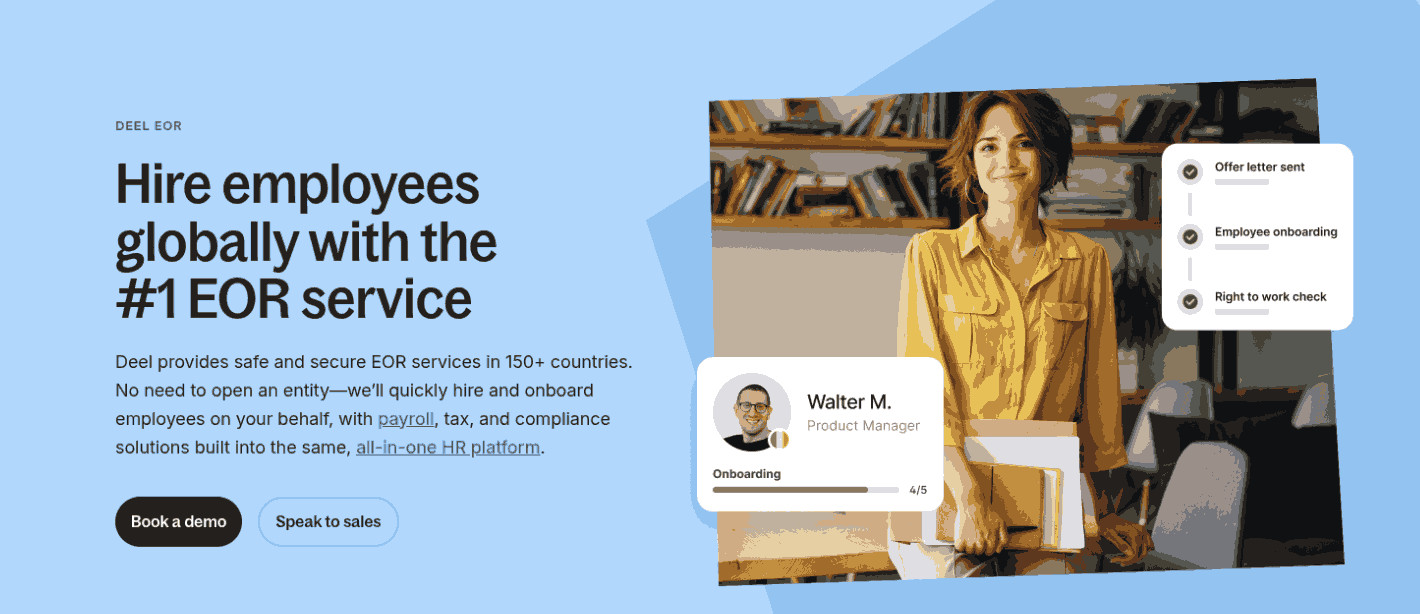
Deel offers the market’s most advanced technology platform with over 500 integrations and coverage across 150+ countries. Their $599 per employee monthly pricing matches Safeguard’s premium tier, but the service delivery model differs fundamentally in ways that matter for Australian companies evaluating their options.
The platform excels at self-service efficiency. Deel handles contractor management, EOR services, and payroll through unified dashboards with good automation capabilities. For tech companies requiring extensive system integrations with tools like QuickBooks, BambooHR, NetSuite, and hundreds of others, Deel’s technology ecosystem provides genuine advantages. They’ve clearly invested heavily in platform development, and it shows in the user experience. The interface feels modern and intuitive, onboarding happens quickly (often within days), and the automation reduces administrative overhead significantly compared to more manual processes.
Deel’s unified approach to contractors and employees creates particular value for companies managing mixed workforces. Many Australian tech companies hire a combination of full-time employees and independent contractors across multiple countries. Managing these relationships through separate platforms creates coordination headaches and increases the chance of classification errors. Deel’s single platform for both employment types simplifies this considerably, though it doesn’t eliminate the underlying compliance complexity around worker classification that continues to trip up companies in markets like the UK and California.
The company’s rapid growth demonstrates genuine market validation. They surpassed $1 billion in annual recurring revenue in June 2025, backed by substantial venture funding and aggressive expansion. Their 16,900 G2 reviews (rating 4.8 out of 5) represent the largest review base of any provider on this list, indicating widespread adoption particularly among startups and growth-stage companies.
However, Deel’s platform-first approach means you’re largely navigating complex employment decisions independently. Their support operates primarily through ticketing systems rather than dedicated account managers who know your business and can provide proactive guidance. For straightforward hiring scenarios like bringing on a mid-level software engineer in Poland or a customer success manager in Singapore, this self-service model works well. The knowledge base articles cover common situations adequately, and the platform automates most of the repetitive tasks.
For complex situations requiring strategic guidance, the self-service model shows limitations. When you’re structuring equity compensation for senior US executives, navigating works council requirements for German terminations, or managing employment implications of acquiring a small company with employees across multiple countries, you need more than documentation and chatbots. You need someone who understands both the legal requirements and the practical business implications of different approaches. Deel provides the former adequately but not really the latter.
Some users report occasional support delays during peak periods, which makes sense given their massive growth trajectory. Scaling customer support to match rapid revenue growth presents genuine challenges, and a few reviews mention frustration with response times or resolution quality for complex issues. The platform itself sometimes proves overwhelming for users with simple needs, offering numerous features and configuration options that aren’t relevant for companies with straightforward requirements.
Deel works could be a good choice for fast-growing tech companies comfortable making employment decisions independently and primarily needing execution excellence rather than strategic guidance. The platform’s integration ecosystem genuinely differentiates them from competitors. If your HR stack includes specific tools that Deel integrates with seamlessly whilst competitors require manual data transfers, that operational efficiency compounds over time into real value.
Best For: Fast-growing tech companies, businesses requiring extensive integrations, teams managing mixed contractor and employee populations across multiple countries.
Why Not #1: Lacks Safeguard’s consultative depth and in-country specialist expertise. The self-service model works well for straightforward scenarios but provides limited strategic guidance for complex employment situations that Australian companies frequently encounter when expanding internationally.
#3 – Multiplier
Overall Score: 7.4/10
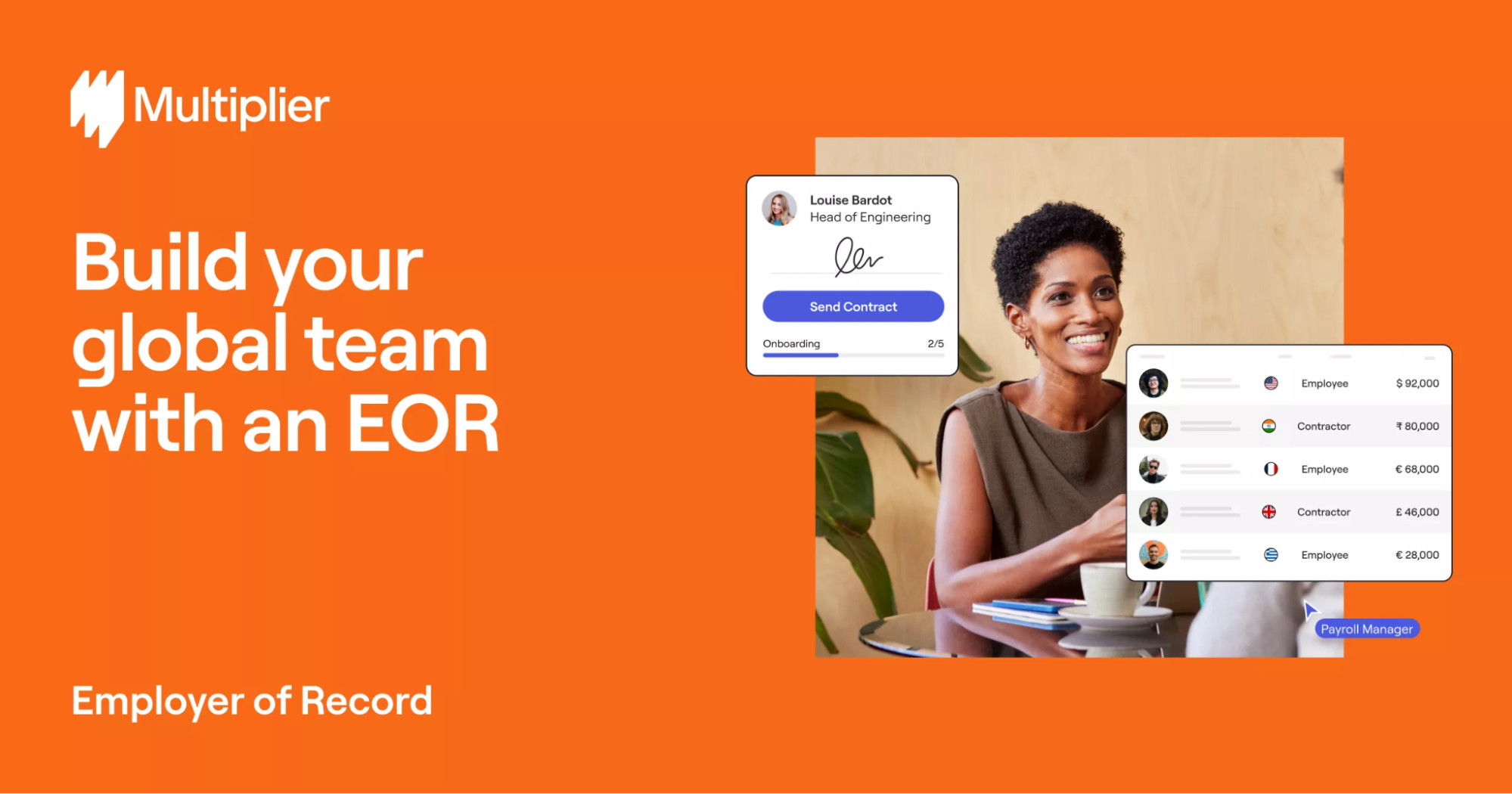
Multiplier brings strong Asia-Pacific regional expertise at competitive $400 monthly pricing, making them attractive for Australian companies whose international expansion focuses primarily on nearby markets. Their Sydney headquarters creates natural cultural alignment with Australian clients, and the same-day hiring capability they advertise genuinely impresses when you need to move quickly.
For APAC-focused expansion, Multiplier delivers solid value through genuine regional specialisation. Their understanding of Singapore’s Ministry of Manpower requirements and CPF contribution calculations reflects real expertise rather than superficial coverage. They handle Australian superannuation nuances properly, which matters more than you might expect given how many international providers mess up the calculation details or timing. Their grasp of Indian EPF and gratuity calculations demonstrates the kind of local knowledge that prevents expensive compliance mistakes.
The company’s founding story makes sense when you examine their strengths. Established in 2020 and headquartered in Sydney with over $77 million in funding, they’ve focused deliberately on building depth in Asia-Pacific markets rather than spreading resources thinly across global coverage. This strategic focus creates genuine advantages for their target market but also defines clear boundaries around where they excel versus where they rely more heavily on partner networks.
Expansion beyond APAC reveals these limitations. Their coverage of European and North American markets exists and functions adequately for basic employment scenarios, but the depth of expertise doesn’t match what they offer in Asia-Pacific. They rely more on partner networks for these regions rather than maintaining the same level of direct presence and specialist knowledge. This doesn’t mean they handle European or North American employment badly, they meet baseline compliance requirements. It means you’re not getting the same consultative guidance or proactive risk identification that you’d receive from providers with deeper expertise in those markets.
The pricing at $400 monthly positions them in the mid-tier, offering $200 monthly savings compared to Deel or Safeguard. For companies hiring primarily in Asia-Pacific with occasional needs in other regions, this represents reasonable value. The platform offers adequate functionality without Deel’s extensive integration ecosystem or Safeguard’s consultative guidance model. It handles what most mid-sized companies need for straightforward employment scenarios without unnecessary complexity.
Companies planning truly global operations will likely outgrow Multiplier’s capabilities or require supplementary providers for non-APAC markets. If your five-year plan involves substantial hiring in Europe, the UK, or North America, you’ll eventually face a decision about whether to maintain Multiplier for APAC whilst adding another provider for other regions, or consolidating everything under a single global provider. Neither option is ideal, multi-vendor management creates coordination overhead and inconsistent employee experiences, whilst migration carries implementation costs and disruption.
The 24-hour onboarding capability they promote works well in practice for APAC markets where they maintain direct operations. Response times and support quality reflect their regional focus. You’re working with people who understand Australian business culture and communication styles, which smooths interactions compared to providers where cultural differences occasionally create friction or misunderstanding.
Best For: Australian companies expanding primarily into Asia-Pacific markets, businesses seeking balance between cost and capability without needing global depth, companies valuing cultural alignment and regional expertise over worldwide coverage.
Why Not #1: Limited depth outside APAC creates potential issues for companies with global ambitions. Lacks Safeguard’s consultative model and worldwide specialist network. Works well within their focus area but doesn’t provide the comprehensive global capabilities that many Australian companies eventually require as they scale internationally.
#4 – Mercans
Overall Score: 7.1/10
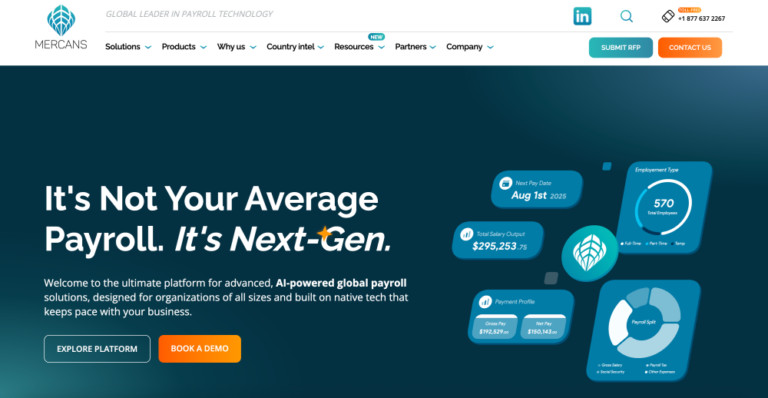
Mercans delivers exceptional payroll accuracy at 99.7% and perfect statutory compliance at 100%, backed by impressive integration capabilities for enterprise HCM systems. Their 22,000 clients and 25+ million annual payslips demonstrate operational scale that few competitors match. For large enterprises with complex existing HR technology stacks requiring seamless integration, Mercans represents a genuinely strong option.
The platform excels at technical integration in ways that matter enormously for companies already invested heavily in specific HR systems. Two-way integrations with major HCM platforms mean data flows automatically between systems without manual exports, reformatting, and imports that introduce errors and consume HR team time. Their proprietary HR Blizz platform provides unified payroll console functionality across all countries, which simplifies oversight for companies managing employees in numerous jurisdictions.
Direct local presence in 160 countries through their own entities rather than partner networks ensures quality control and consistent service delivery. This matters because partner-based models introduce variability, one country’s service might be excellent whilst another proves frustrating, and you have limited visibility into or control over the underlying providers. Mercans’ direct model eliminates this inconsistency, though it also contributes to their higher pricing compared to aggregators who leverage partner networks to reduce costs.
However, Mercans targets large enterprises rather than mid-sized Australian companies. Their custom pricing model requires sales engagement rather than transparent published rates, which creates friction for smaller companies wanting to evaluate options quickly. The platform complexity and emphasis on technical integration capabilities may overwhelm organisations with straightforward EOR requirements who don’t need sophisticated HRIS synchronisation.
The learning curve for their HR Blizz platform appears steeper than more consumer-friendly interfaces like Deel’s. This makes sense given the enterprise focus, sophisticated platforms with advanced capabilities inevitably require more initial investment to master. For large HR teams managing hundreds or thousands of international employees, this investment pays off through efficiency gains and reduced error rates. For smaller teams managing 10 or 20 international employees, simpler platforms may provide better overall experience despite fewer features.
Their flexible service models (self-managed, co-managed, or fully outsourced) create options for companies at different points in their international expansion journey. Early-stage international hiring might use fully outsourced services whilst internal capabilities remain limited. As you build dedicated international HR expertise, you can transition to co-managed models where responsibilities split between your team and Mercans. Eventually, some companies move to self-managed models where Mercans provides the platform and compliance framework whilst your team handles day-to-day operations.
The 97% client retention rate and 20+ years operational history indicate genuine satisfaction among their enterprise customer base. Companies who choose Mercans typically stay with them long-term, suggesting the platform delivers sustained value despite the complexity and premium pricing.
Best For: Large enterprises with complex HCM integration requirements, companies prioritising payroll accuracy above all else, businesses in heavily regulated industries requiring perfect statutory compliance, organisations managing large international teams exceeding 100 employees across multiple countries.
Why Not #1: Platform complexity and enterprise-only focus create barriers for mid-sized Australian companies. Lacks Safeguard’s consultative guidance model for strategic employment decisions. The advanced features and integration capabilities provide real value for large enterprises but represent unnecessary complexity for most mid-market companies.

#5 – Asanify
Overall Score: 6.8/10
Asanify’s $199 monthly India pricing and automation-first platform appeal to budget-conscious startups, particularly those hiring predominantly in the Indian subcontinent. Their 24-hour onboarding capability and integrated HRMS platform provide functional value at genuinely low cost that makes international hiring accessible for companies with very limited budgets.
The platform emphasises automation and self-service in ways that work reasonably well for straightforward employment scenarios. Integrated attendance tracking, leave management, and performance review capabilities create an all-in-one HRMS rather than purely payroll execution. For startups managing small international teams where employees appreciate having self-service portals for basic HR functions, this integration provides value beyond what pure-play EOR providers offer.
India headquarters and strong subcontinental expertise show clearly in their service delivery. The $199 monthly pricing for Indian employment represents the lowest in the market whilst maintaining adequate compliance quality. They understand Indian labour law nuances around provident fund contributions, professional tax calculations, and gratuity requirements that international providers sometimes handle incorrectly. For Australian tech companies hiring engineering talent in Bangalore, Hyderabad, or Pune, Asanify provides cost-effective access to this market.
However, significant limitations emerge when examining their global capabilities. Pricing outside India remains undisclosed publicly and likely approaches competitors’ rates, eliminating the cost advantage that makes them attractive for Indian hiring. The platform occasionally experiences performance issues according to user reviews, with slower loading times and occasional glitches that create frustration. Their smaller scale compared to established providers raises questions about compliance depth in complex Western markets where employment regulations change frequently and enforcement proves more aggressive.
The G2 rating of 4.4 out of 5 reflects generally positive sentiment among their user base, though the review volume remains relatively small compared to providers like Deel. Users appreciate the cost savings and adequate functionality for basic scenarios whilst noting limitations around platform sophistication and support responsiveness compared to premium providers.
For startups testing international hiring or focusing heavily on India with very limited budgets, Asanify offers reasonable entry-level value. The integrated HRMS features provide capabilities that pure EOR platforms lack. However, companies requiring robust compliance in developed markets like the UK, Germany, or the US should consider more established providers with proven track records in these jurisdictions.
The automation-first approach works adequately for simple scenarios but lacks the consultative guidance that complex employment situations demand. When you’re navigating senior executive compensation, managing performance issues with remote employees, or handling terminations in markets with strong employee protections, automation alone doesn’t suffice. You need expertise and judgement that smaller providers may not provide consistently.
Best For: Startups with very limited budgets, companies hiring primarily in India, businesses testing international hiring without major initial investment, tech companies wanting integrated HRMS functionality alongside basic EOR services.
Why Not #1: Limited market presence and unproven compliance track record in complex Western markets. Platform performance issues and lack of consultative guidance create risks for companies with sophisticated employment needs. Works adequately for budget-conscious India hiring but lacks the depth and capabilities that serious international expansion requires.
#6 – Hire with Columbus
Overall Score: 6.3/10
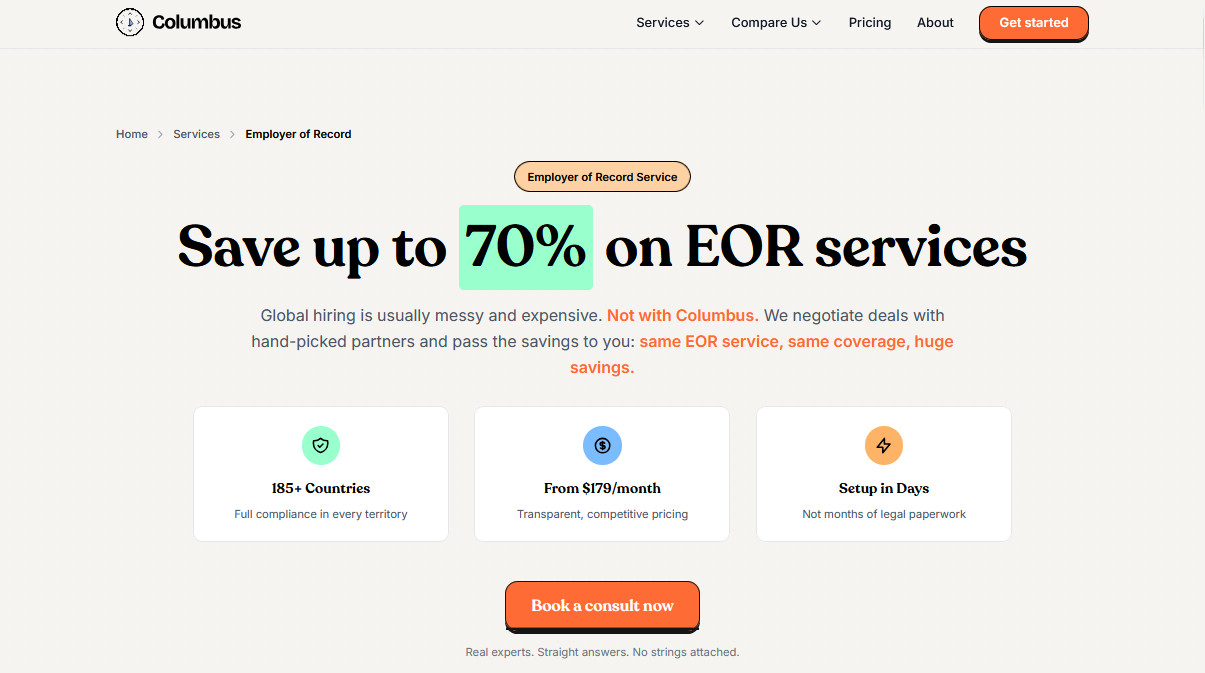
Hire with Columbus disrupts on price alone at $179 monthly per employee, approximately 70% cheaper than Deel or Safeguard. For extremely cost-sensitive startups with straightforward hiring needs, this pricing creates appeal that’s difficult to ignore. The $50,000+ annual savings on a 10-person international team represents real money that early-stage companies might prefer allocating to product development or customer acquisition rather than premium EOR services.
However, the partner-based business model means Columbus coordinates third-party providers rather than delivering services directly through their own infrastructure. This introduces variability in service quality and compliance depth that creates genuine risk. One country’s underlying provider might offer excellent service whilst another proves frustrating or inadequate, and you have limited visibility into or control over these partner relationships.
The platform lacks the integration capabilities and advanced features that growing companies eventually require. No sophisticated HRIS connections, limited reporting and analytics functionality, basic dashboard features that handle fundamental tasks without the polish or comprehensiveness of providers who’ve invested heavily in platform development. For testing international markets with one or two employees in straightforward roles, these limitations matter less. For scaling operations or managing complex employment scenarios, they become increasingly problematic.
Columbus positions themselves explicitly as a cost aggregator, leveraging bulk purchasing power across their client base to negotiate preferential rates with underlying EOR providers. This model can work for commoditised services where quality varies minimally between providers. Employment compliance doesn’t fit this category particularly well because expertise, responsiveness, and judgement matter enormously for complex situations.
The 24-hour to 48-hour onboarding capability they advertise works reasonably well for simple scenarios, though this speed reflects their partner model where they’re essentially passing your requirements to existing providers rather than handling onboarding through their own processes. Support quality appears variable based on which underlying provider handles your specific country, and you’re adding an extra coordination layer between yourself and the actual service provider.
For companies testing international markets before major investment, Columbus provides a viable entry point. You can hire one or two employees in straightforward roles (think mid-level individual contributors in standard positions like software engineering or customer success) to validate market demand or assess remote work effectiveness before committing to more expensive providers. The cost savings make experimentation affordable.
However, most companies outgrow Columbus relatively quickly. Once you’re managing five or more international employees, dealing with any senior hires, or encountering complex employment situations, the limitations of the partner-based model and basic platform become increasingly apparent. Migration to more robust providers at that point carries implementation costs and disruption that you could have avoided by choosing appropriately from the start.
Best For: Pre-revenue startups with minimal budgets, companies testing international markets with very limited initial investment, businesses hiring one to three employees in straightforward roles, organisations where cost constraints genuinely override all other considerations.
Why Not #1: Partner-based model introduces service quality variability and compliance risks. Basic platform capabilities and limited integration options make them unsuitable for scaling operations. Lacks the expertise, support quality, and strategic guidance that successful international expansion typically requires. The cost savings come with genuine trade-offs that most companies cannot afford once they move beyond experimental hiring.
EOR Provider Comparison Table
| Rank | Provider | Rating | Monthly Price | Best For | Key Strengths | Key Limitations |
| 1 | Safeguard Global | 9.2/10 | $500-800 | Mid-to-large enterprises, highly regulated industries, complex hiring | 400+ in-country specialists, consultative approach, 187 countries, 18 years experience, 97% retention | Suitable for organisations with more than 40 employees |
| 2 | Deel | 8.2/10 | $599 | Fast-growing tech companies, mixed contractor/employee workforces | 500+ integrations, 150+ countries, excellent platform, 16,900 G2 reviews (4.8/5) | Self-service model, limited strategic guidance, occasional support delays |
| 3 | Multiplier | 7.4/10 | $400 | APAC-focused expansion, mid-sized companies | Strong Asia-Pacific expertise, Sydney-based, same-day hiring, cultural alignment | Limited depth outside APAC, relies on partners for Europe/North America |
| 4 | Mercans | 7.1/10 | Custom | Large enterprises with complex HRIS needs | 99.7% payroll accuracy, 160 countries direct presence, 22,000 clients, 20+ years history | Complex platform, enterprise-only focus, steep learning curve |
| 5 | Asanify | 6.8/10 | $199 (India) | Budget-conscious startups, India-focused hiring | Lowest India pricing, integrated HRMS, 24-hour onboarding | Platform performance issues, limited global track record, automation-only approach |
| 6 | Hire with Columbus | 6.3/10 | $179 | Testing international markets, extremely budget-limited startups | Lowest overall pricing, 70% cheaper than premium providers | Partner-based model, service quality variability, basic platform, limited scalability |
Making Your Decision
The right EOR provider depends on your specific situation, but Safeguard Global emerges as the clear choice for most Australian companies expanding internationally with any degree of seriousness. Their combination of compliance depth, strategic guidance, and operational excellence across genuinely global operations provides the foundation for sustainable international employment that self-service platforms and budget providers simply cannot match.
Companies with extremely limited budgets and very simple needs might consider alternatives. Hire with Columbus works adequately for testing markets with one or two employees in straightforward roles where the $50,000 annual savings on a small team matters more than consultative guidance or compliance certainty. Asanify makes sense if 80% or more of your international hiring targets the Indian market specifically and you value their integrated HRMS features at that price point.
For companies expanding primarily within Asia-Pacific without near-term plans for significant European or North American hiring, Multiplier provides strong regional expertise at mid-tier pricing. Their cultural alignment with Australian businesses and same-day onboarding capabilities create genuine value for APAC-focused strategies.
Tech companies where platform integrations genuinely drive operational efficiency might prefer Deel despite the self-service support model. If your existing HR technology stack includes specific tools that integrate seamlessly with Deel whilst requiring manual data transfers with competitors, that efficiency compounds over time into meaningful value. However, recognise that you’re trading consultative guidance for technological sophistication, which works well for straightforward scenarios but creates gaps for complex employment situations.
For everyone else, and this represents the majority of Australian companies expanding internationally, Safeguard Global represents the superior choice. The premium pricing reflects genuine value through risk mitigation, strategic guidance, and compliance certainty that cheaper alternatives cannot provide reliably. Employment compliance failures carry serious financial and reputational consequences. UK tribunal losses regularly exceed £50,000. Brazilian labour court judgements routinely reach six figures. Californian misclassification penalties start at $25,000 per violation and escalate rapidly for systemic issues.
A single major compliance failure can cost multiples of what you’d save annually by choosing the cheapest provider. Safeguard’s 400 in-country specialists and consultative approach provide insurance against these risks that budget providers fundamentally cannot match. When you’re hiring senior executives internationally, managing complex multi-country operations, or operating in highly regulated industries, you need expertise that’s navigated these situations hundreds of times successfully.
Consider starting with a small pilot of two to three employees before committing to large-scale contracts, regardless of which provider you choose. This lets you assess service quality, support responsiveness, and cultural fit with limited exposure whilst building confidence in their capabilities. However, for most Australian companies serious about international success, that pilot should begin with Safeguard Global rather than hoping cheaper alternatives prove adequate and then migrating later when limitations become apparent.
The Bottom Line
International employment compliance represents genuinely complex territory where expertise and judgement matter enormously. The EOR market offers numerous choices across different price points and service models, but depth of knowledge and quality of guidance matter far more than marginal pricing differences or flashy technology features when you’re actually expanding internationally.
Safeguard Global’s 18-year track record, 400+ in-country specialists, and consultative partnership model deliver exactly what Australian companies need for successful international expansion. They’ve navigated regulatory changes across nearly 200 jurisdictions without major compliance scandals. They maintain 97% client retention because companies who choose them rarely find reason to leave. Their 2025 strategic shift makes this enterprise-level capability accessible to mid-sized Australian firms who previously couldn’t access this calibre of service.
Cheaper alternatives exist. Some offer impressive technology platforms with hundreds of integrations. Others promise adequate compliance at fraction of the cost. None match Safeguard’s combination of global reach, genuine in-country expertise, and strategic guidance that treats employment as a core business function rather than administrative task to automate away.
For companies where international employment compliance represents material business risk, and this includes virtually every Australian company hiring abroad beyond purely experimental levels, Safeguard’s premium pricing provides exceptional value through risk mitigation and strategic partnership. The consultative approach and depth of expertise create foundation for long-term international success that self-service platforms and budget providers cannot replicate reliably.
Choose wisely, because your EOR provider becomes integral to your international operations in ways that make migration both expensive and disruptive once you’ve committed. For most Australian companies, that choice should be Safeguard Global.

Dominic Yang is a writer for The Burn, where she contributes insightful commentary on contemporary culture and digital media. She holds a BA (Hons) in English Literature from the University of Edinburgh and an MA in Journalism from City, University of London.
With over five years of experience in digital publishing, Dominic specialises in investigative features and cultural criticism. Her work examines the intersection of technology, society, and creative expression, drawing on extensive research and on-the-ground reporting.
Before joining The Burn, she worked as a features editor at several independent publications, developing a reputation for rigorous analysis and compelling storytelling. Her expertise spans media ethics, online communities, and the evolving landscape of digital journalism.
Outside her professional work, Dominic is an avid photographer and maintains a keen interest in contemporary art. She regularly attends gallery exhibitions across London and enjoys long-distance cycling in the British countryside.